Industrial machining is an essential technique in the field of precision engineering. It involves manufacturing parts by removing material from a blank to achieve extremely precise dimensions, shapes, and finishes. This method is indispensable in many industries, such as aerospace, automotive, electronics, and machine manufacturing.
The main methods of industrial machining
Turning
First of all, turning is a technique in which the workpiece rotates around its axis. The cutting tool moves along the workpiece to remove material. This method is ideal for manufacturing cylindrical parts, such as shafts or gears.
Milling
In contrast, milling keeps the workpiece stationary and rotates the cutting tool (the milling cutter) to remove material. Thanks to this relative motion, this technique allows for the creation of complex shapes, grooves, flat surfaces, and detailed contours.
Here are a few examples of more precise machining methods used in turning and milling :
Drilling
Drilling, for example, involves creating holes in a material using a drill bit. It is commonly used to prepare parts before applying other machining techniques.
Bore
Similarly, reaming is used to enlarge an existing hole in order to achieve tighter tolerances.
Tapping
In addition, tapping is used to create internal threads in various materials, such as metal, plastic, or wood, using a tap.
Thread cutting
Thread cutting, on the other hand, involves cutting spiral grooves into a workpiece to enable screw connections.
Correction
Grinding uses abrasive wheels to achieve highly precise surface finishes. It also allows for the removal of small amounts of material. This technique is particularly well-suited for highly detailed finishing operations.
Machine tools for precision industrial machining :
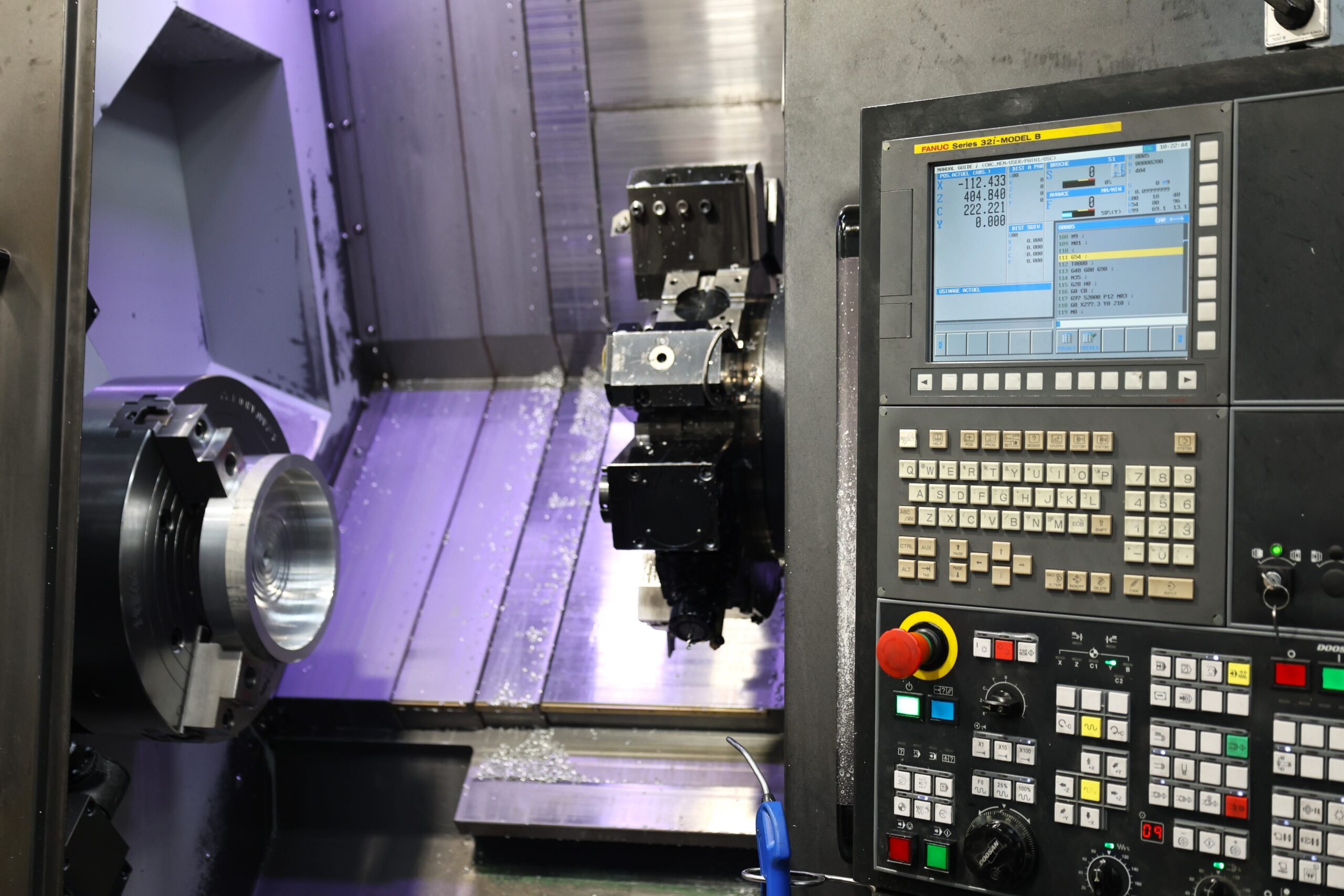
Today, precision machining relies primarily on computer numerical control (CNC) machines. These computer-controlled machines automate movements with high precision, ensuring perfect repeatability. For example, CNC milling machines, CNC lathes, and machining centers are state-of-the-art equipment used in precision engineering.
The CNC Machining Center
A CNC machining center uses rotating cutters to remove material and create complex shapes. It can also be used to machine flat surfaces, grooves, pockets, contours, and other milled shapes.
The CNC Tour
The CNC lathe is designed to machine cylindrical parts. The workpiece rotates around its axis while the cutting tool moves to create diameters, threads, or tapered surfaces.
The benefits of precision machining:
Precision machining offers several significant advantages in the manufacture of parts :
1 - Dimensional Accuracy
This method produces extremely precise dimensions, which are crucial in applications where tolerances must be met.
2 - Surface Finishing
Precision machining produces high-quality finishes, reducing the need for additional finishing operations.
3 - Versatility
In addition, precision machining produces high-quality finishes, reducing the need for additional finishing operations.
4 - Repeatability
Finally, CNC machines offer exceptional repeatability, making it possible to produce runs of identical parts with consistent quality.
In summary, precision machining is undeniably an essential discipline in the field of mechanical engineering. Indeed, thanks to the use of modern machine tools and CNC technology, manufacturers are now able to produce complex parts while ensuring remarkable quality, precision, and repeatability. As such, this method is crucial in many industries, particularly in sectors as diverse as aerospace, medical devices, and the automotive industry. Furthermore, thanks to continuous innovation and the rapid development of new machining technologies, the future of precision engineering is already taking shape, opening up endless possibilities for the years to come.