In the precision engineering industry, professionals join metals through fusion to meet the needs of a wide range of applications, including the nuclear, food processing, aerospace, and medical sectors. Indeed, the fields of welding and sheet metal fabrication enable the transformation of sheet metal into complex welded assemblies. These processes ensure the strength and precision of the manufactured parts.
Welding
Professionals use a variety of welding processes, each suited to specific needs. Here are the most common ones.
TIG Welding (Tungsten Inert Gas)
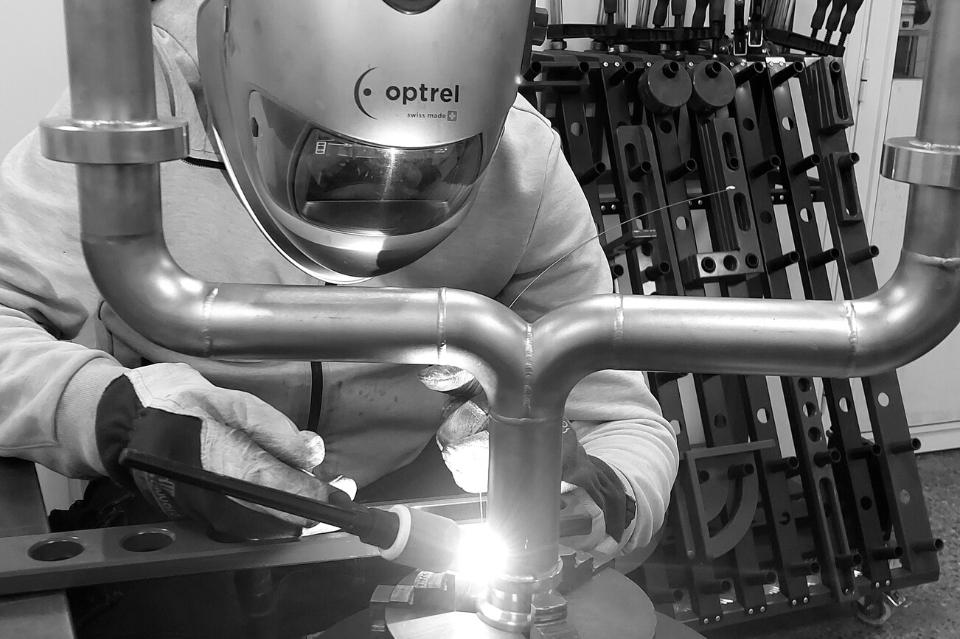
The welder creates an electric arc between the workpiece and a non-consumable tungsten electrode. The arc generates enough heat to melt the metal, and the welder can manually add filler metal to reinforce the weld. Additionally, they use an inert gas (argon or helium) to protect the weld from oxidation. As a result, professionals prefer this process in high-precision industries, such as aerospace.
MIG Welding
Professionals use MIG welding, a process widely used in industry. They create an electric arc between the workpiece and the filler wire. Once the arc is established, they feed the filler wire into the molten pool created by the arc, resulting in a strong, uniform weld. They perform this process under gas shielding, which ensures high-quality results.
Arc Welding (Covered Electrode)
In the arc welding process, a coated electrode is used to join the parts. An electric arc is generated at a high temperature (up to 3200°C), which melts the steel and forms a weld. It is important to note that the filler metal, melting into the weld pool, ensures a strong bond between the parts. Thus, this process is particularly well-suited for industrial applications where weld strength is critical.
Spot Welding
Spot welding joins two metal parts by applying pressure between two electrodes. This process is highly effective for quickly assembling thin-walled parts, and professionals commonly use it in the automotive industry as well as in other sectors where productivity is essential.
Boiler making
Sheet metal fabrication refers to the range of techniques used to work with sheet metal, tubes, and profiles to manufacture equipment for various industrial sectors. This equipment is used in fields such as food processing, chemicals, energy (oil, gas, nuclear), aerospace, and the construction of metal structures.
The skills of a boilermaker
A sheet metal worker must have a thorough understanding of metal forming principles, such as elongation and shrinking. These skills are essential for producing parts that meet industry standards. To do this, they use manual techniques (forming, stamping, bending) or mechanical methods (CNC machines).
Material deformation
Sheet metal can be shaped either manually, using tools such as hammers and mallets, or mechanically. Mechanization, however, allows for greater precision and the ability to handle larger production volumes. Nevertheless, in traditional craftsmanship, certain manual techniques are still used for pieces that require a high degree of finesse.
two closely related fields
In industry, welders and sheet metal workers perform complementary roles. In fact, in many cases, a single professional combines these two skill sets. For example, the sheet metal worker prepares the parts to be welded to ensure they fit together perfectly, which makes the welder’s job easier. The welder then applies the appropriate welding techniques to join the parts securely.
During welding, the heat from the electric arc causes distortions. These distortions alter the geometry of the parts and complicate their assembly. The sheet metal worker then steps in to correct these distortions, either manually or using specialized machines. In this way, they ensure the parts comply with industrial standards.
Finally, when geometric tolerances are strict, parts are sometimes manufactured to rough dimensions. They are then reworked through machining to achieve the exact required dimensions. This step guarantees maximum precision in the manufacture of complex assemblies.
We invite you to learn more about the world of precision machining and explore our technical processes by visiting our specialized pages. They will provide you with an in-depth understanding of high-precision methods and applications.